
DAPAI · LITHIUM FORKLIFT BATTERY SYSTEMS
Forklift LiFePO4 Battery Systems
A lithium forklift battery system brings LiFePO4 traction power, intelligent battery management and a vehicle-specific pack design to electric forklifts and AGVs. First, match the truck voltage, battery tray and work cycle; then review the charger and connector before ordering.
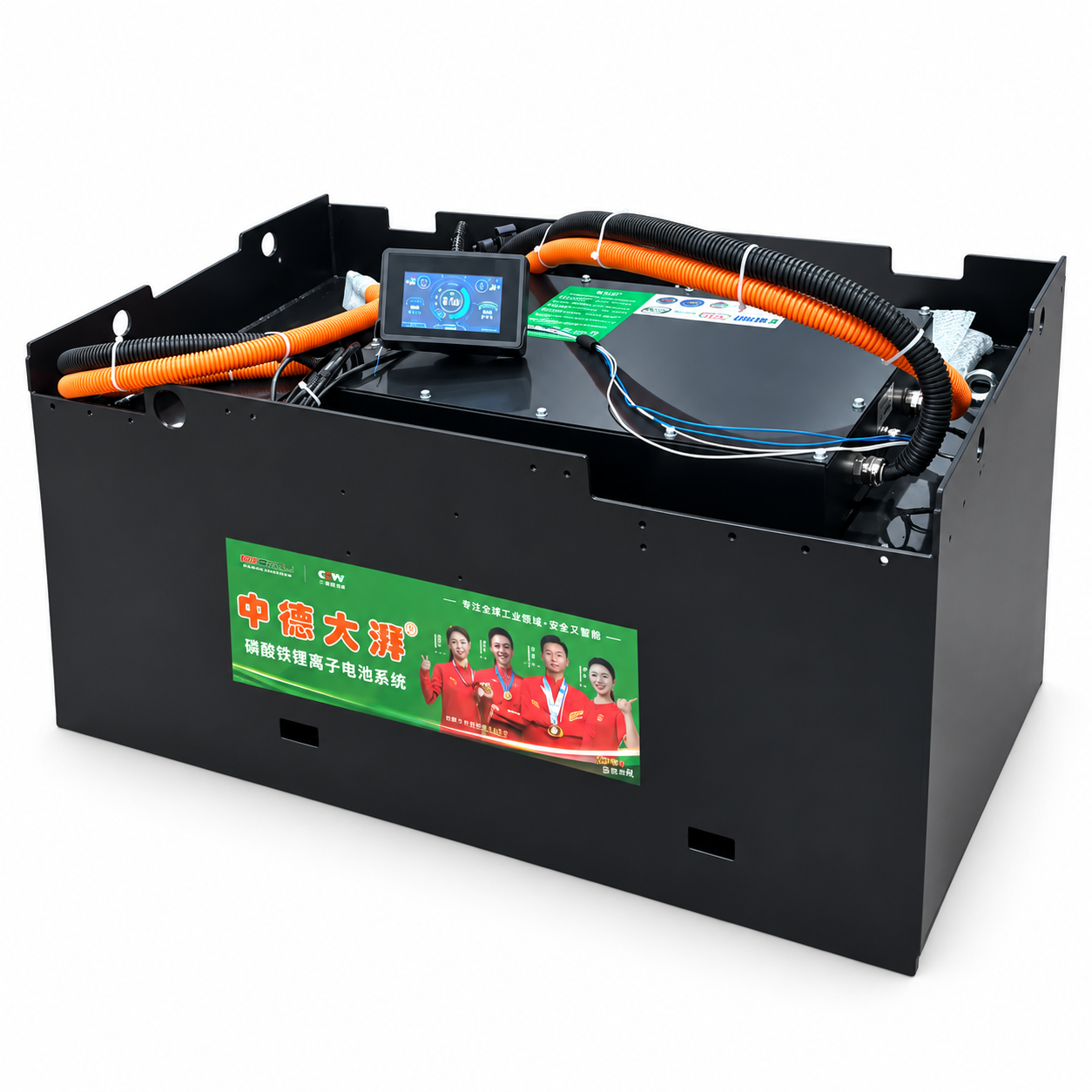
Built for material handling
Power matched to your truck and work cycle.
DAPAI lithium forklift battery packs use lithium iron phosphate cells and are configured around the vehicle platform, battery tray and operating pattern. The product catalogue covers electric forklifts and forklift AGVs, with representative systems from 24V to 80V and multiple voltage and capacity combinations.
For suitably configured fleets, opportunity charging during planned breaks can help keep equipment available across shifts. Therefore, confirm the battery, charger profile and duty cycle together before deployment. For general charging and handling context, review OSHA’s electrical power source guidance and follow the selected equipment instructions.
Pack capacity, output current, charger settings, enclosure dimensions and counterweight requirements are selected for the specific truck.
System advantages
Engineered as a Complete Lithium Forklift Battery System
From cell-level monitoring to enclosure and vehicle interfaces, specify the features around your material-handling application.
LiFePO4 Chemistry
Stable traction power, high energy density and long cycle life, as described in the product catalogue.
Generation II I-BMS
Battery status management with cell balancing and configured protection for charging and discharging.
GPS & Remote Monitoring
Optional GPS positioning, remote data monitoring and wireless mobile-app communication, depending on model.
Lithium Forklift Battery Fit
Metal case, connector, display port and pack layout configured to the truck installation and project needs.
Representative catalogue models
Lithium forklift battery model range
Use these sample specifications for initial planning. Final voltage, dimensions, current limits and weight must be confirmed against the selected pack drawing.
| Catalogue model | Nominal voltage / capacity | Charge current | Discharge current | Dimensions (L×W×H) | Listed weight | |
|---|---|---|---|---|---|---|
| 24V230Ah | 25.6V / 230Ah | 30–100A | 230A | 650 × 500 × 240mm | 110kg* | Product Details |
| 24V300Ah | 25.6V / 300Ah | 30–200A | 300A | 600 × 285 × 550mm | 350kg* | Product Details |
| 48V346Ah | 48V / 346Ah† | 30–200A | 346A | 840 × 620 × 520mm | 500kg* | Product Details |
| 48V400Ah | 51.2V / 400Ah | 30–200A | 400A | 1035 × 400 × 600mm | >500kg | Product Details |
| 48V420Ah | 51.2V / 420Ah | 30–200A | 420A | 1025 × 780 × 550mm | 980kg* | Product Details |
| 48V460Ah | 51.2V / 460Ah | 30–200A | 460A | 990 × 632 × 610mm | 820kg* | Product Details |
| 48V560Ah | 51.2V / 560Ah | 30–200A | 560A | 830 × 630 × 627mm | >600kg | Product Details |
| 72V412Ah | 76.8V / 412Ah | 30–200A | 412A | 1138 × 680 × 790mm | >1250kg | Product Details |
*The catalogue marks these weights as including counterweight in some model entries; verify the exact supplied configuration. †The 48V346Ah entry lists 48V nominal voltage and 58.4V charge cut-off in the source catalogue. Confirm the electrical configuration with DAPAI before ordering. Catalogue-listed charge temperature: 0–55°C; discharge temperature: −20–60°C, subject to model and configuration.
Protection & monitoring
Lithium Forklift Battery Monitoring & Protection
Configure the information and safeguards needed by the vehicle, charger and fleet team.
Battery status
Monitor pack status and configured data such as voltage, current, temperature and state of charge.
Protection functions
Catalogue examples include overcharge, over-discharge, overcurrent and short-circuit protection, plus cell balancing.
Remote communication
GPS, remote monitoring and mobile-app wireless communication can be selected for compatible projects.
CUSTOMER INPUTS FOR A QUOTE
Details Needed for a Lithium Forklift Battery Quote
For a replacement or fleet project, share the forklift brand and model, rated voltage, existing capacity, tray dimensions, connector, charger details and shift pattern. As a result, the battery pack, charger settings, enclosure and counterweight requirements can be aligned with the vehicle.
For example, multi-shift fleets should include planned opportunity-charging windows and required operating hours. Review the forklift battery fitment directory by brand and the forklift replacement battery guide before requesting a quotation.
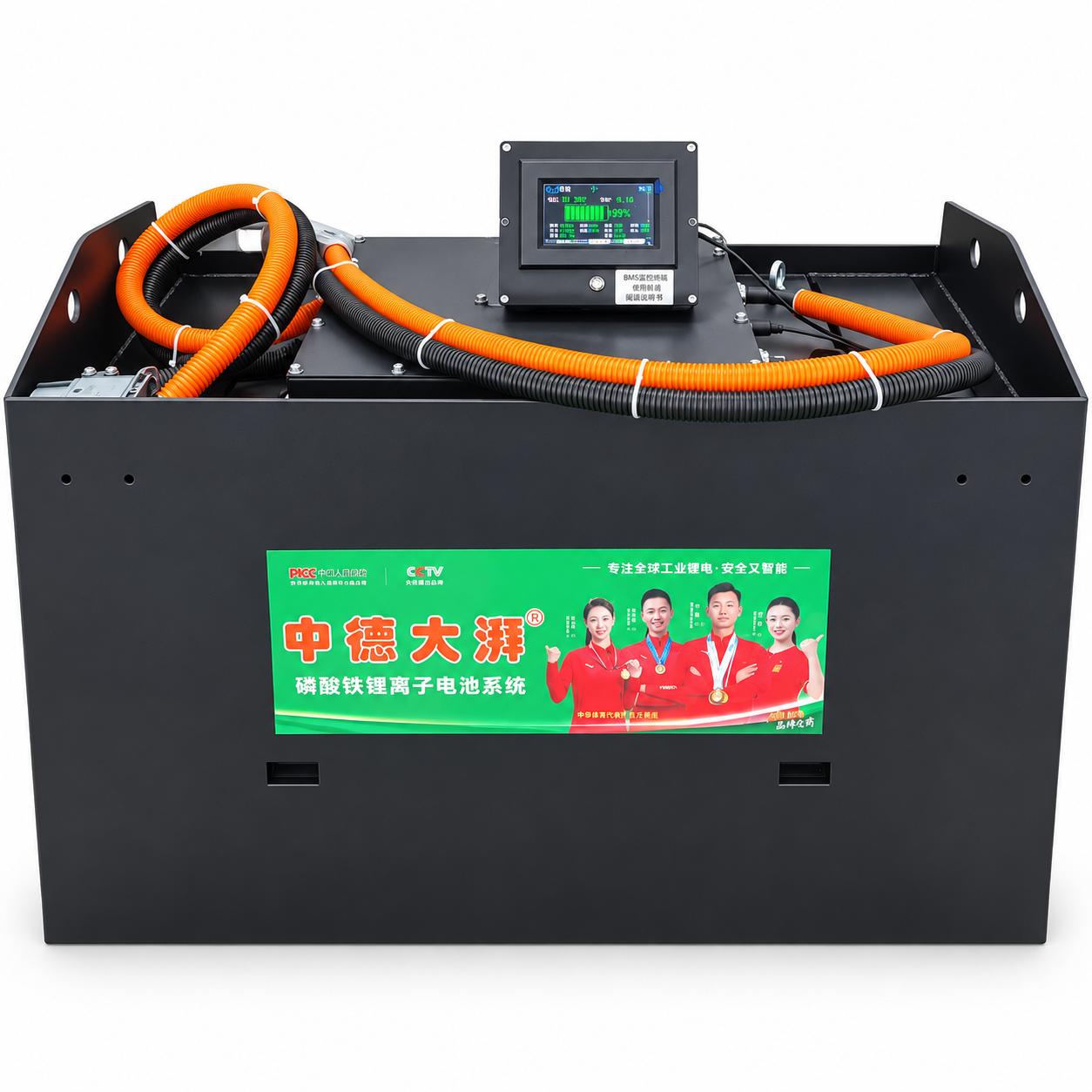
Application fit
Specify the battery around the real job.
A good selection starts with the vehicle and work cycle. Share key installation details so the battery capacity, charger and enclosure can be reviewed together.
- Forklift brand and model
- Required voltage and capacity
- Battery tray dimensions
- Connector and charger details
- Shift schedule and daily duty
- Counterweight requirements
Frequently asked questions
Lithium forklift battery selection guide
Start with the truck specifications and operating schedule; DAPAI can help review the configuration.
Please provide the forklift brand and model, required voltage and capacity, battery tray dimensions, connector type and operating environment. A heating system may be needed for low-temperature cold storage. The lithium battery should have approximately the same weight as the lead-acid battery; confirm the truck manufacturer’s minimum battery weight and counterweight requirements. If additional runtime is required, a higher-capacity battery may be considered.
Before selecting a replacement, check the truck voltage, tray fit, counterweight, charger configuration and vehicle communication. A project-specific assessment is recommended.
Lithium batteries can feature GPS tracking, remote monitoring, Bluetooth communication with mobile apps, and a Battery Management System (BMS) that automatically cuts off power in the event of overheating.
For lithium battery charging, you can select an appropriate charger based on the battery’s capacity; the fastest charging time can be as short as 1–2 hours. Please refer to the charger specifications.Industrial Lithium Battery Chargers
OEM / ODM project enquiry
Match a Lithium Forklift Battery to Your Truck
Send the vehicle model, tray dimensions, rated voltage, desired capacity and operating schedule. DAPAI can review the battery and charger configuration for your application.
Please verify model-specific ratings, compatible charger settings, dimensions and any required approvals before purchase or installation.
Planning a replacement? Review our forklift replacement battery guide for a checklist of voltage, capacity, tray dimensions, battery weight and charger compatibility.
CUSTOMER BUYING QUESTIONS
Questions to Ask When Buying a Lithium Forklift Battery
The right forklift battery must match the truck, battery tray, charger and daily duty cycle.
Confirm the Forklift brand, model, voltage, capacity, tray dimensions, connector, battery weight and counterweight requirements.
Generally, lithium batteries offer about 15% longer runtime compared to lead-acid batteries of the same capacity; if a longer range is required, the battery capacity can be increased accordingly.
Charging time depends on the battery chemistry, charger power, AC supply, connector and compatibility with the battery management system and CAN communication.
Compared to lead-acid batteries—which have shorter lifespans and require frequent maintenance—lithium batteries offer a superior price-performance ratio, potentially reducing long-term costs by approximately 50%. They are particularly well-suited for high-intensity operational environments and the forklift rental industry.
Given that forklifts are typically operated in environments such as factories and warehouses, we have prioritized robust fire safety measures. The batteries utilize lithium iron phosphate (LiFePO4) cells from the renowned manufacturer CATL—a chemistry that does not catch fire—rather than ternary lithium cells, which are prone to thermal runaway and combustion. Furthermore, the system is equipped with a Battery Management System (BMS) that includes high-temperature protection and temperature-limiting functions.
Yes, lithium batteries offer superior performance in low-temperature environments (below -20°C). For use in cold regions or enclosed cold-storage facilities—even down to -50°C—an optional battery heating system can be integrated, effectively resolving the issue of performance degradation caused by low temperatures.
For a faster recommendation, provide the forklift model, existing battery label, tray dimensions, connector photos, charger details and shift schedule. Compare our lithium forklift battery chargers, replacement battery guide and compatibility assessment service.
LITHIUM FORKLIFT BATTERY CHALLENGES
Address the Issues That Interrupt Your Shifts
Before switching from lead-acid to lithium or replacing an existing lithium pack, assess the most important operating risks.
Runtime and voltage drop
Select capacity for the forklift, load, operating hours and shifts to reduce the risk of work stopping early due to voltage drop.
Charging cannot keep up
Match charger power, charging current, AC supply and charging windows to the production schedule.
The battery is incompatible with the forklift.
Before placing an order, please confirm details regarding pallet dimensions, connectors, polarity, weight, counterweights, and vehicle communication requirements. We can provide the perfect solution to address your concerns.
Cold storage reduces performance
Confirm charging and discharging temperature limits and the protections required for cold storage.
Safety and overheating concerns
Check BMS alarms, overcurrent and overtemperature protection, enclosure design, ventilation and emergency procedures.
High upfront cost
Compare energy, maintenance, labor, spare batteries, warranty and expected cycle life to estimate return on investment.
Unclear capacity and warranty
Ask about test conditions, usable capacity, performance degradation limits, warranty coverage and service response.
Limited visibility into fleet status
Use accurate state-of-charge (SOC) reporting, display data, alerts and optional remote monitoring to plan charging.
Need model-specific advice? Compare the STILL, CROWN and Mitsubishi fitment pages, then send the truck nameplate and battery tray dimensions to DAPAI.
SELECTION & COMPATIBILITY
Lithium Forklift Battery Compatibility & Sizing Guide
The catalogue covers representative forklift systems from 24V to 80V. Use the truck nameplate and original battery data to identify the required voltage; then size capacity around the load, shift length, work intensity and planned charging windows. Confirm all limits against the selected model drawing and battery data.
| Check | How to select |
|---|---|
| Voltage & Forklift/Stacker | Match the truck’s specified nominal voltage and verify controller voltage limits. Share the forklift brand, model and serial number for configuration review. |
| Capacity & duty cycle | Estimate energy needs from operating hours, load profile, travel/lift intensity and shifts. Review available Ah/kWh ratings under their stated test conditions; do not compare figures taken at different discharge rates. |
| Physical & counterweight fit | Verify enclosure dimensions, mounting, connector, cable reach and supplied weight. Lithium packs can weigh less than lead-acid packs; confirm the truck’s minimum battery weight and any counterweight requirement. |
| BMS, charger & signals | Match continuous/peak current, charger voltage/current and charging profile. Confirm BMS communication protocol, pinout and display/controller signals before purchase. |
Compare before you choose
Lead-acid and LiFePO4 systems differ in charging, maintenance, weight and vehicle interfaces. Opportunity charging is suitable only when the selected battery, charger and duty cycle support it. Compare lifecycle and operating requirements with the lead-acid traction battery information.
For a model-specific recommendation, send the equipment or system model, existing battery label, required voltage, capacity or load, dimensions, charger details and operating schedule. Final fit and settings must be confirmed against the selected model data.
CONTINUE EXPLORING
Related products & charging options
Compare the application and battery technology. Confirm the charging profile and compatibility before selection.
Traction batteries and maintenance considerations.
Match charging voltage, profile and communication.
Custom packs for low-speed vehicle applications.
Model 24V230Ah: 25.6V nominal and 230Ah. Review dimensions, charging and counterweight fit.
Model 48V400Ah: 51.2V nominal and 400Ah. Review dimensions, charging and counterweight fit.